Introduction: Force vs Design
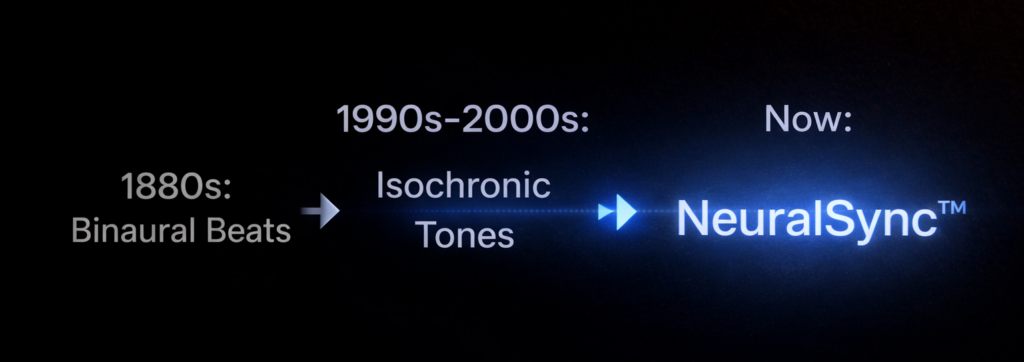
Isochronic tones were introduced as a response to the limitations of binaural beats. By using a single tone that turns on and off at a fixed rate, they created a much more obvious auditory pulse — and for many users, a more noticeable short-term effect.
This led to a common conclusion:
If isochronic tones feel stronger, they must be better.
But strength is not the same as sophistication.
NeuralSync™ represents a different philosophy entirely — not louder stimulation, but architectural synchronization.
What Isochronic Tones Do (and Don’t Do)
Isochronic tones work by rapidly switching a single tone on and off at a specific frequency. This creates a rhythmic pulse that the brain can easily detect.
Format
-
One audible tone
-
Regular on/off pulsing
Delivery
-
Can be played without headphones
-
Often louder than binaural beats
Result
-
Faster initial entrainment for some users
-
More noticeable stimulation during playback
The Strength — and the Ceiling — of Isochronic Tones
Isochronic tones do create a stronger evoked response than binaural beats. That is not in dispute.
However, this strength introduces new limitations:
-
Static repetition
One pulse rate, repeated continuously. -
Rapid habituation
The nervous system adapts quickly to repetitive stimuli. -
Fatigue potential
Many users report irritation or discomfort over longer sessions. -
Amplitude dependence
Effectiveness often relies on louder playback.
Isochronic tones increase force. They do not increase coherence.
Why Louder Stimulation Is Not Deeper Entrainment
The brain is not a metronome.
It is a dynamic, adaptive system.
Forcing a fixed rhythm through repeated pulses may create short-term entrainment, but it does not address:
-
Cross-hemispheric coordination
-
Dynamic frequency interaction
-
System-level regulation
This is the hidden ceiling of isochronic tones.
How NeuralSync™ Moves Beyond Pulses Entirely
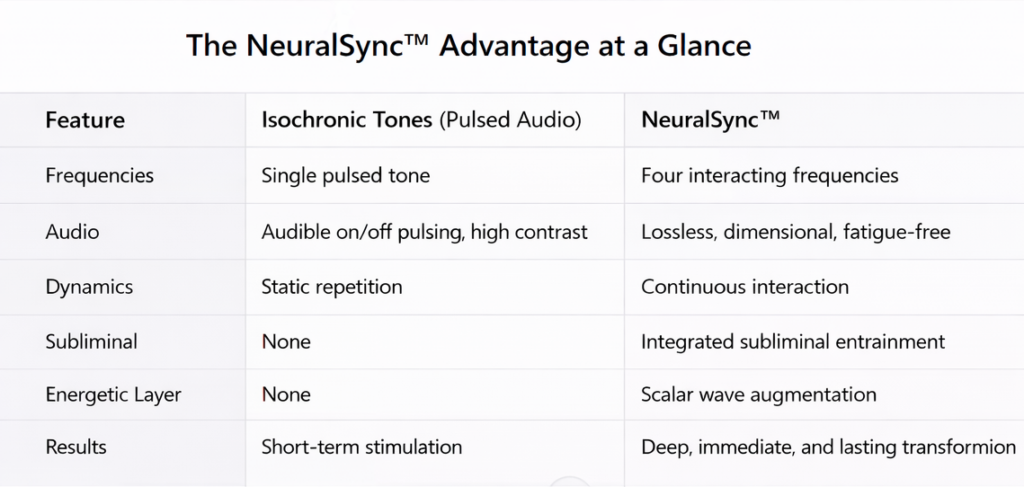
NeuralSync™ does not rely on repetitive pulsing.
Its 4-W.T.S.P.™ architecture operates with multiple concurrent frequencies interacting dynamically, supported by:
-
Frequency sweeps and channel crossing
-
Lossless, fatigue-free audio design
-
Zero-point scalar augmentation
Rather than driving the brain harder, NeuralSync™ engages it more intelligently.
Core Differences
-
Mechanism
Isochronic tones pulse. NeuralSync™ synchronizes. -
Adaptability
Isochronic tones repeat. NeuralSync™ evolves. -
Listening Experience
Isochronic tones can feel intrusive. NeuralSync™ remains immersive and balanced. -
Outcome
Isochronic tones stimulate states. NeuralSync™ builds coherence.
Real-World Experience
-
Isochronic tones
Strong sensation during playback, often followed by a quick return to baseline. -
NeuralSync™
Sustained shifts that persist beyond the session.
Why Users Eventually Outgrow Isochronic Tones
Many report:
-
“It worked, but felt harsh.”
-
“I couldn’t listen for long.”
-
“The effect didn’t last.”
NeuralSync™ was created to move beyond force-based entrainment entirely.

How to Experience the NeuralSync™ Difference
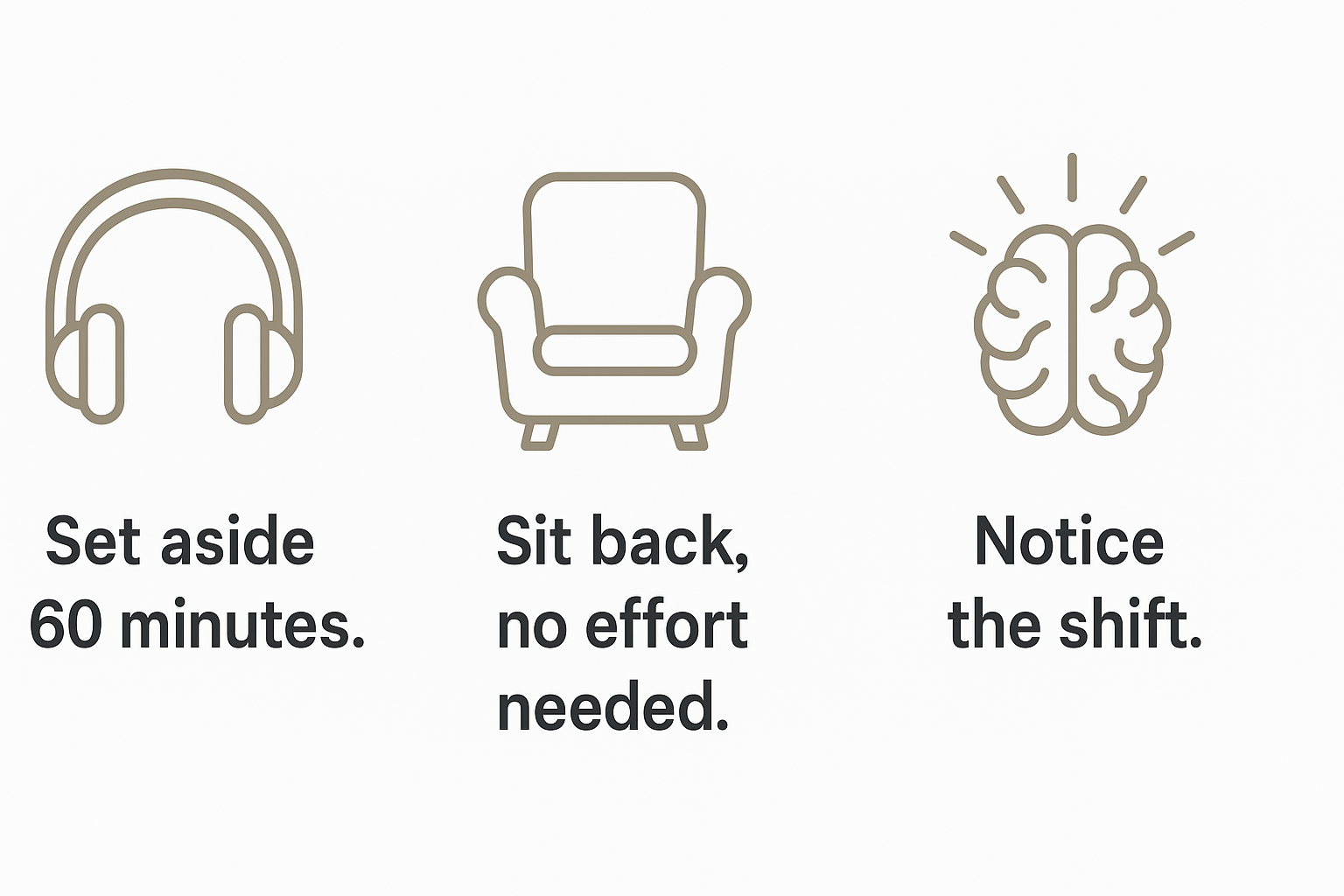
Using NeuralSync™ is as simple as isochronic tones—but infinitely more effective:
- Set aside 60 minutes. No multitasking.
- Use quality headphones for dimensional sound.
- Listen without effort—the structure does the work.
- Notice the shift—calmer mood, clearer mind, energized body.
Unlike isochronic tones, NeuralSync™ is not background filler. It’s active, structured and engineered to re-pattern your brain and energy system.
Final Word: Pulses Were a Step — Not the Destination
Isochronic tones addressed the weakness of binaural beats by increasing force.
NeuralSync™ addresses the deeper issue by redesigning the entire approach.
If you’re ready to move past repetition and experience a fully engineered neuro-frequency architecture, NeuralSync™ offers a fundamentally different path.
Conceptual comparisons are useful, but the real differences emerge through direct experience.
- NeuralSync™ vs Holosync®
- NeuralSync™ vs Hemi-Sync®
- NeuralSync™ vs Brain Sync
- NeuralSync™ vs EquiSync®
- NeuralSync™ vs iAwake®
- NeuralSync™ vs Brain.fm
- NeuralSync™ vs BrainEv
For a full definition of the system, see What Is NeuralSync™ Neuro-Frequency Technology
To experience NeuralSync™ for yourself, start here.