NeuralSync™ vs Muse: Two Completely Different Paths to Brain Change
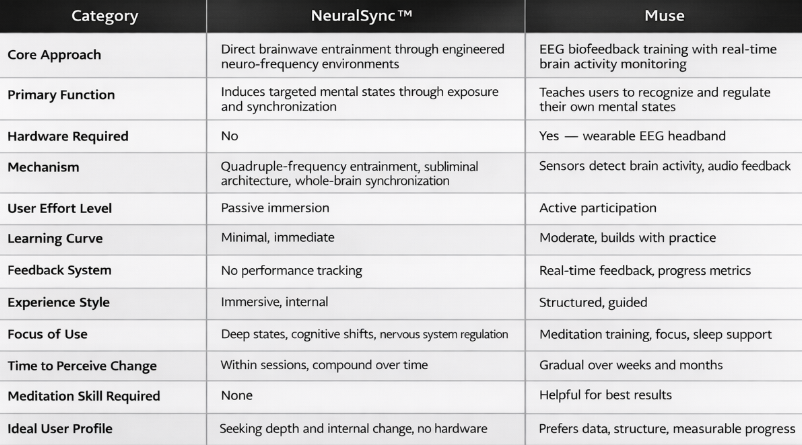
The rise of consumer neurotechnology has created a new category of tools designed to influence mental states, improve focus and support meditation. Among the most recognized names is the Muse headband, a wearable EEG device that tracks brain activity and provides real-time feedback. NeuralSync™, by contrast, is not a wearable, not an app and not a biofeedback system. It is a multi-dimensional neuro-frequency technology designed to directly guide the brain into targeted states.
At a surface level, both occupy the same psychological territory: people searching for relief from stress, deeper meditation, better sleep, stronger focus or expanded consciousness. But the mechanism, experience and intent behind them are fundamentally different.
This comparison clarifies what each actually does, who each is for and where their strengths diverge.
What Muse Is (And What It Is Designed to Do)
Muse is a wearable EEG headband developed by InteraXon that measures electrical brain activity through sensors placed on the forehead and behind the ears. The device connects to a mobile app and converts brain signals into audio feedback to help users improve meditation practice.
Key characteristics:
Uses electroencephalography (EEG) sensors to monitor brain activity
Provides real-time biofeedback during meditation sessions
Converts mental activity into sound cues (calm vs active mind)
Tracks additional biometrics like heart rate, breathing and movement (in newer models)
Includes guided meditations, progress tracking and sleep monitoring
Muse does not attempt to change brain activity directly. Instead, it acts as a mirror. It shows users what their brain is doing, moment to moment, and trains them to recognize when they are focused, calm or distracted.
For example, the system may play gentle nature sounds when the mind is calm and storm-like sounds when attention drifts, giving immediate feedback to help develop meditation skill.
It is best understood as:
A neurofeedback coach
A meditation trainer
A brain-activity tracking tool
Studies and user reports suggest it can help encourage mindfulness, improve consistency and deepen meditation practice over time through repeated training.
What NeuralSync™ Is Designed To Do
NeuralSync™ is not a tracker and not a coaching tool. It is a direct intervention system.
Rather than measuring brain activity and asking the user to change it, NeuralSync™ uses engineered neuro-frequency architecture to guide the brain into specific patterns automatically through exposure and entrainment.
Core distinctions:
No wearable hardware required
No EEG monitoring
No self-training process
No performance scoring or feedback loop
Instead, NeuralSync™ uses:
Quadruple-frequency entrainment (four simultaneous frequencies)
Rhythmic + subliminal entrainment
Dynamic frequency sweeps and channel crossing
Dimensional soundscapes designed for whole-brain synchronization
Scalar augmentation
Hololiminal™ subliminal architecture
Rife/MOR frequency sessions (when applicable)
The goal is not to teach the user to meditate better. The goal is to move the brain into targeted states directly.
The Core Difference: Measurement vs Induction
This is the single most important distinction.
Muse measures the brain.
NeuralSync™ influences the brain.
Muse approach:
“Here is what your brain is doing”
“Try to calm it”
“Learn to maintain focus”
NeuralSync™ approach:
Deliver structured frequency environments
Guide neural activity toward target states
Encourage whole-brain synchronization
Muse relies on conscious skill development. NeuralSync™ relies on engineered entrainment and exposure.
One is training.
The other is induction.
Experience Comparison
Muse Experience
Using Muse involves an active, intentional process:
Wear the headband
Open the app
Start a guided session
Listen to feedback sounds
Try to maintain focus
Track progress metrics
It rewards consistency and discipline. Over time, users may become better at recognizing when they are distracted and returning to a calm state.
For many, this creates structure and accountability.
But it is still effort-driven.
The results depend heavily on:
User engagement
Meditation ability
Consistency
Motivation
Muse helps you learn to change your state.
NeuralSync™ Experience
NeuralSync™ is immersive rather than instructional.
You listen.
The session environment is engineered to:
Encourage state shifts
Promote whole-brain activity
Guide the nervous system
Support deep mental immersion
There is no performance tracking. No scoring. No feedback sounds. No need to “do it right.”
This makes it accessible to:
People who struggle to meditate
People who want deeper states without years of practice
People interested in consciousness exploration
People focused on internal change rather than performance metrics
Hardware vs Environment
Muse is a hardware product.
It requires:
Wearing a device
Charging it
Pairing with an app
Maintaining sensor contact
NeuralSync™ is an environmental intervention.
It requires:
Headphones
Time and immersion
The difference may sound small, but psychologically it is significant.
Hardware creates friction.
Environment creates absorption.
Outcome Orientation
Muse Focus Areas
Muse is primarily designed for:
Meditation training
Stress reduction
Mindfulness development
Sleep tracking
Focus awareness
It helps users observe and improve mental discipline.
NeuralSync™ Focus Areas
NeuralSync™ is oriented toward:
Deep internal states
Cognitive shifts
Emotional processing
Consciousness exploration
Nervous system regulation
Whole-brain synchronization
It is less about training the mind and more about changing the internal environment the mind operates within.
Feedback vs Surrender
Muse reinforces control.
You watch your metrics.
You adjust.
You improve.
NeuralSync™ reinforces immersion.
You let go.
You experience.
You allow the state to unfold.
These are opposite psychological modes.
Some people thrive with structured feedback.
Others go deeper through surrender and absorption.
Time Horizon
Muse tends to be progressive:
Skill improves over weeks and months
Meditation ability builds gradually
Awareness increases with practice
NeuralSync™ tends to be experiential:
States can deepen within a session
Exposure compounds over time
Internal responses vary by individual sensitivity
Who Muse Is Best For
Muse may be a strong fit for:
Beginners learning meditation
People who want data and metrics
Analytical personalities
Habit-builders
Biofeedback enthusiasts
People who enjoy tracking progress
It turns meditation into something measurable.
Who NeuralSync™ Is Best For
NeuralSync™ resonates most with:
People who struggle to quiet the mind
People seeking deeper internal states
Individuals drawn to consciousness exploration
People who prefer immersion over performance
Individuals interested in nervous system support
Users seeking a non-hardware experience
It removes the learning curve and replaces it with guided state exposure.
Philosophical Difference
Muse is built around a coaching philosophy:
“Train the mind.”
NeuralSync™ is built around an environmental philosophy:
“Change the conditions the mind exists within.”
This is the deeper dividing line.
One develops skill.
One changes state.
Final Perspective
Muse and NeuralSync™ are not direct competitors in the traditional sense. They operate in the same psychological space but through completely different mechanisms.
Muse:
A biofeedback teacher
A meditation performance tracker
A wearable training tool
NeuralSync™:
A multi-dimensional neuro-frequency system
A state-induction environment
A whole-brain synchronization platform
Both can exist in the same personal toolkit.
But they answer different questions:
Muse asks:
“How well can you control your mind?”
NeuralSync™ asks:
“What happens when your brain is guided into deeper states?”
For a full definition of the system, see What Is NeuralSync™ Neuro-Frequency Technology
If you’d like to explore NeuralSync™ before committing to individual programs, start with Experiences, the curated gateway collection.