What Is Brainwave Entrainment? The Science, History and Modern Innovations with NeuralSync™
Brainwave entrainment is the process of guiding the brain’s electrical rhythms using rhythmic external stimuli such as sound, light or electromagnetic signals.
Quick Answer: What Is Brainwave Entrainment?
Brainwave entrainment is the process of guiding the brain’s electrical rhythms using rhythmic external stimulation such as sound, light or electromagnetic signals. When the brain is exposed to stable repeating frequencies, neural activity tends to synchronize with that rhythm through a mechanism known as the frequency following response. This synchronization can influence mental states associated with relaxation, focus, sleep or meditation.
The Brain as an Oscillatory System
The brain does not operate in a single fixed mode. Neural activity constantly shifts through patterns of electrical timing as different networks coordinate with each other.
Neurons communicate through electrical impulses, and when large populations of neurons fire together they produce measurable rhythmic activity. These rhythms are recorded through electroencephalography (EEG) and are commonly referred to as brainwaves.
Brainwaves are simply the electrical signature of coordinated neural firing.
Faster rhythms tend to appear during outward attention, problem-solving and analytical thinking. Slower rhythms are more common during relaxation, sleep and inward awareness.
The brain moves between these modes continuously depending on physiology, emotional state, environment and cognitive demand.
Brainwave entrainment interacts with this timing system by introducing an external rhythm that the brain can synchronize with.
What Entrainment Means
The concept of entrainment originates in physics. When two oscillating systems interact, they often begin to synchronize.
Examples of entrainment appear throughout nature:
Pendulums placed near each other gradually begin swinging together
Fireflies flash in coordinated patterns
Crowds unconsciously match tempo when clapping
Music pulls the nervous system toward its pacing
The nervous system is particularly responsive to rhythm because many biological systems already operate through timing cycles, including breathing rhythms, heart rhythms and circadian rhythms.
Brainwave entrainment uses this natural responsiveness to rhythm by presenting a repeating external signal that the brain begins to align with.
The Frequency Following Response
One of the most studied mechanisms behind auditory entrainment is the frequency following response.
When the auditory system receives a steady rhythmic pulse, neural activity in sensory and attentional networks begins to reflect the frequency of the external signal.
This does not mean the entire brain becomes locked into a single frequency. Instead, specific neural networks increase their coordination around the rhythmic input.
That increased coordination can influence mental state.
Because brain activity is closely linked to attention, relaxation and sleep cycles, guiding neural timing can shift the conditions under which the brain operates.
Brainwave Frequencies and States of Consciousness
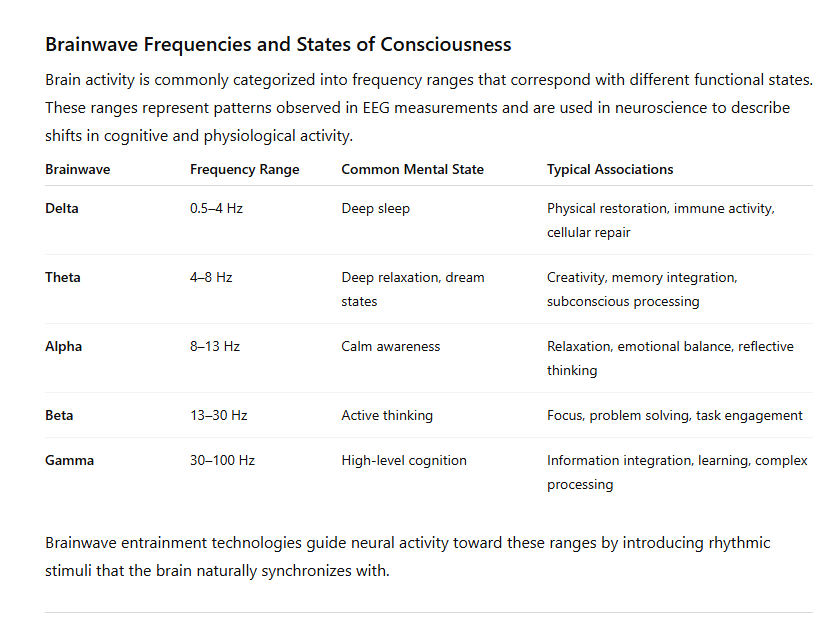
Researchers commonly describe brain activity using several frequency ranges that correspond with different functional states.
Delta (0.5–4 Hz)
Delta rhythms are most often observed during deep sleep and physical restoration. These states are associated with bodily repair processes and nervous system recovery.
Theta (4–8 Hz)
Theta activity appears during deep relaxation, dreaming and meditative states. It is often linked with creativity, memory processing and inward attention.
Alpha (8–13 Hz)
Alpha rhythms are associated with calm awareness and relaxed focus. They often appear during reflective thinking, learning and light meditation.
Beta (13–30 Hz)
Beta activity dominates during active thinking, problem-solving and task engagement. Excessive beta activity is commonly associated with stress or mental overactivation.
Gamma (30–100 Hz)
Gamma rhythms are linked with complex cognition, memory integration and high-level information processing.
Brainwave entrainment does not create these states artificially. Instead it helps the brain access them more consistently by providing a stable rhythmic guide.
What Brainwave Entrainment Influences
Brainwave entrainment is best understood as state guidance rather than control of thought. It does not insert ideas into the mind or override cognition.
Instead it influences the background conditions under which the brain is operating.
Several effects are commonly associated with rhythmic entrainment.
Attention Stabilization
Modern mental fatigue often results from cognitive fragmentation. Constant switching between stimuli creates scattered attention and mental noise.
Rhythmic entrainment provides a stable sensory anchor. Because the brain naturally locks onto patterns, attention can become less scattered and easier to sustain.
Nervous System Downshifting
Many individuals live in chronic sympathetic activation, a physiological state associated with vigilance and stress.
Slower entrainment rhythms can encourage a shift toward parasympathetic activity, the state associated with recovery and relaxation.
Emotional Settling
Emotional states are closely tied to neural activity. When brain rhythms stabilize, emotional tone often shifts as well. Entrainment therefore influences emotional experience indirectly by affecting neural timing.
Increased Neural Coherence
The brain functions as a coordinated network rather than isolated regions. Under stress or sleep deprivation this coordination can fragment.
Rhythmic entrainment may support coherence by providing a stable timing reference that neural systems can organize around.
Types of Brainwave Entrainment Methods
Several approaches are used to introduce rhythmic stimulation that can influence brain activity.
Binaural Beats
Two slightly different frequencies are presented separately to each ear. The brain perceives the mathematical difference between the tones as a rhythmic beat.
Isochronic Tones
A single tone is pulsed repeatedly at a specific interval, producing a clearly defined rhythmic signal.
Monaural Beats
Beat patterns are embedded directly in the audio waveform before reaching the ears.
Audio-Visual Entrainment
Some systems combine rhythmic sound with flashing light patterns to increase stimulation.
Layered Entrainment Systems
More sophisticated approaches use multiple rhythmic layers, spatial audio design and dynamic frequency changes to create a more complex entrainment environment.
The engineering quality of the signal strongly influences how effective the entrainment response becomes.
Why Many Brainwave Entrainment Systems Are Limited
Many entrainment products rely on simplified approaches such as static binaural beats or repetitive pulsed tones.
These models assume that presenting a single frequency is sufficient to guide complex brain activity.
In reality the brain is not linear.
Neural activity involves:
- multiple brain regions operating simultaneously
- continuous transitions between states
- interhemispheric communication
- adaptive responses over time
Simplistic entrainment signals often lead to shallow effects, listener fatigue and inconsistent results.
Many commercial entrainment systems rely on simplified signal structures such as binaural beats. For a detailed comparison of traditional entrainment technologies and newer approaches, see our analysis of NeuralSync™ vs other brainwave entrainment systems.
From Traditional Entrainment to NeuralSync™
For a complete explanation of the system framework, see What Is NeuralSync™ Neuro-Frequency Technology.
While traditional entrainment methods demonstrate that rhythmic stimulation can influence brain activity, most systems stop at relatively simple signal structures such as binaural beats or pulsed tones. These approaches can guide neural timing, but they rarely address the broader complexity of the brain as a dynamic, multi-layered system.
NeuralSync™ was developed to move beyond these limitations. Instead of relying on a single entrainment technique, the platform combines multiple synchronized elements that influence neural timing, subconscious processing and informational patterning simultaneously. The result is a more comprehensive neuro-frequency system designed to support deeper states of regulation, cognitive clarity and internal coherence. NeuralSync™ programs.
How NeuralSync™ Advances Brainwave Entrainment
Traditional brainwave entrainment systems typically rely on simple rhythmic signals such as binaural beats or isochronic tones. While these methods can influence neural timing, they often operate with limited structural depth and static frequency patterns.
NeuralSync™ was developed to expand beyond these linear models by combining multiple synchronized elements that operate simultaneously across neural, cognitive and informational layers.
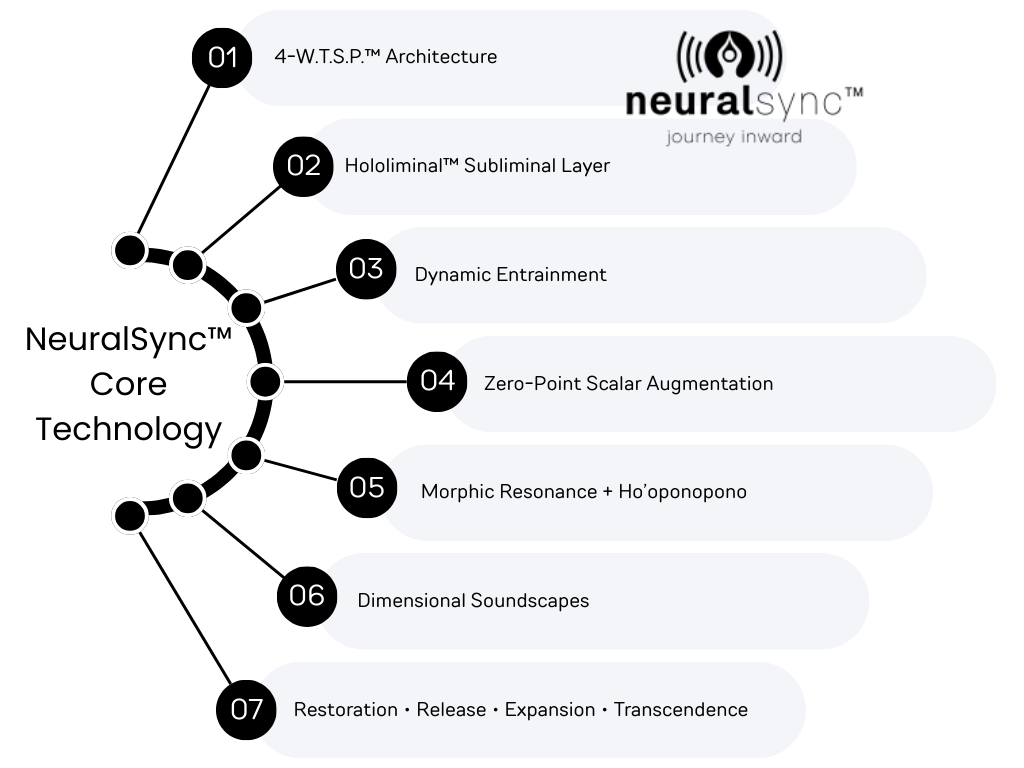
The system integrates several distinct components that together create a more sophisticated entrainment environment.
4-Wave Tonal Synchronization Process™ (4-W.T.S.P.™)
Most entrainment recordings use one or two tones presented at a fixed frequency. NeuralSync™ employs quadruple-frequency entrainment, allowing multiple rhythmic signals to interact simultaneously.
Rather than guiding the brain toward a single static frequency, this approach creates a dynamic entrainment environment in which several coordinated signals influence neural timing across multiple regions of the brain.
This multi-signal structure helps support deeper and more stable entrainment while reducing the habituation that can occur with repetitive tones.
Rhythmic and Subliminal Entrainment Layers
NeuralSync™ combines audible entrainment signals with subliminal layers designed to influence subconscious processing while the rhythmic entrainment is occurring.
This dual-layer design allows conscious awareness and subconscious processing to be engaged simultaneously, creating a more immersive cognitive environment during listening sessions.
Hololiminal™ Subliminal Architecture
Hololiminal™ technology represents a proprietary subliminal messaging structure within the NeuralSync™ system.
Unlike conventional subliminal techniques that rely on simple hidden affirmations, Hololiminal™ messaging is embedded within the audio environment using spatial and rhythmic patterning designed to interact with the listener’s subconscious processing pathways.
Hololiminal™ functions independently from the entrainment signals themselves, providing an additional informational layer within the listening experience.
Ho’oponopono and Morphic Resonance Integration
NeuralSync™ also incorporates principles derived from Ho’oponopono, a traditional Hawaiian practice centered on emotional reconciliation and internal alignment.
Within the NeuralSync™ system, Ho’oponopono elements are integrated through morphic resonance principles. Morphic resonance describes the concept that patterns of information can influence biological and psychological systems through resonance-based interactions.
By embedding Ho’oponopono patterns within the system architecture, NeuralSync™ introduces an informational component designed to support emotional clearing and internal coherence alongside neurological entrainment.
Zero-Point Energetic Augmentation
All NeuralSync™ programs incorporate scalar energetic augmentation, intended to support systemic balance and energetic coherence.
This component operates alongside the entrainment framework rather than replacing it, contributing an additional layer intended to promote whole-system regulation.
Rife Frequencies and MOR Therapy Programs
In addition to brainwave entrainment sessions, NeuralSync™ also offers programs based on MOR therapy (Mortal Oscillatory Rate) and Rife frequency principles.
These recordings differ structurally from entrainment programs.
MOR therapy requires pure, unblended frequencies rather than layered entrainment signals. For this reason:
• frequencies remain clean and unmodulated
• 4-W.T.S.P.™ entrainment is not applied
• dimensional soundscapes are not layered over the frequencies
This approach preserves frequency precision while still allowing scalar energetic augmentation to be incorporated.
The result is a system that includes both entrainment-based cognitive programs and frequency-pure MOR therapy recordings, each designed for different functional purposes.
A Multi-Layered Neuro-Frequency System
By combining rhythmic entrainment, subliminal architectures, informational resonance principles and MOR frequency technologies, NeuralSync™ operates as a multi-layered neuro-frequency system rather than a simple entrainment audio track.
This integrated structure allows NeuralSync™ sessions to influence mental state, neural timing and informational patterning simultaneously, expanding the scope of what traditional brainwave entrainment systems can achieve.
Brainwave Entrainment and the Nervous System
Brainwave patterns are closely linked to the state of the nervous system.
When the brain remains dominated by high beta activity, the nervous system often stays in a state of persistent alertness. This pattern is commonly associated with chronic stress and difficulty relaxing.
By supporting access to alpha, theta and delta rhythms, brainwave entrainment can encourage the nervous system to shift toward recovery states.
Because entrainment operates through passive rhythmic stimulation, it can also assist individuals who find traditional meditation difficult or inaccessible.
Brainwave Entrainment and Neuroplasticity
Neuroplasticity refers to the brain’s ability to reorganize its neural connections over time.
While entrainment does not directly rewire the brain on its own, repeated access to regulated brain states can support conditions in which plastic change becomes more likely.
Regular exposure to coherent neural rhythms may help reinforce healthier baseline patterns associated with emotional stability, learning and cognitive clarity.
For this reason entrainment systems are typically designed for repeated use rather than isolated listening sessions.
What Brainwave Entrainment Does Not Do
Is brainwave entrainment real?
A realistic understanding of entrainment requires acknowledging its limits.
Brainwave entrainment does not:
- permanently rewire the brain in a single session
- produce identical results for every individual
- replace necessary medical treatment
- force the brain into involuntary trance states
It influences neural timing rather than controlling cognition.
Why Results Vary Between Individuals
The response to entrainment varies because the brain is adaptive rather than mechanical.
Factors that influence responsiveness include:
- baseline stress levels
- sleep quality
- sensory sensitivity
- audio quality and headphone accuracy
- consistency of listening
Because entrainment depends on the relationship between stimulus and nervous system state, individual experiences naturally differ.
How to Use Brainwave Entrainment
Most auditory entrainment systems work best when used with headphones in a quiet environment.
Basic guidelines include:
- choose sessions aligned with the desired mental state
- allow the nervous system time to settle into the rhythm
- avoid excessive multitasking during sessions
- use sessions consistently over time
Brainwave entrainment works through cumulative exposure rather than a single listening session.
The Practical Value of Brainwave Entrainment
In modern environments the brain is often pushed toward continuous stimulation and cognitive fragmentation.
Rhythmic entrainment offers a structured signal that can help the nervous system settle into more stable rhythms.
For many individuals the primary value of entrainment is access to mental states that may otherwise be difficult to reach, including relaxation, sustained focus and restorative sleep.
Experience Brainwave Entrainment with NeuralSync™
NeuralSync™ programs apply advanced neuro-frequency engineering to guide the brain into states associated with relaxation, focus, sleep and expanded awareness. If you want to experience how these principles work in practice, start with Experiences, a curated collection designed as a direct introduction to the NeuralSync™ system.
Summary
Brainwave entrainment is the process of guiding neural rhythms through rhythmic external stimulation.
By synchronizing parts of brain activity with repeating signals, entrainment technologies can influence mental state, attention patterns and nervous system regulation.
The concept draws from both ancient rhythmic practices and modern neuroscience research. While early entrainment methods relied on simple signals such as binaural beats, newer systems such as NeuralSync™ use multi-layered frequency frameworks designed to produce deeper and more stable neural coordination.
In a world saturated with cognitive noise and constant stimulation, the ability to guide mental state through rhythm remains a powerful and practical tool for restoring balance and clarity.